
Executive Intelligence
I am not particularly visual and I've always hated the "a picture is worth a thousand words" argument, but . . .

In this weird world of worshiping wealth as some sort of measure of intelligence, I am reminded of one of my weirder moments in medical device reliability assurance. Sometime around 2000, one of the products I was responsible for monitoring was failing at a higher-than-expected rate, fairly early in the product-life-cycle. It should have had about 3-5 year life expectancy with regular use, but the Ventak II Implantable Cardioverter Defibrillators (ICDs) were self-destructing sooner than that and in a manner that could present a patient hazard. (That would, and should, result in a Class 1 FDA recall, but which didn’t happen for three more generations of Guidant Ventak products. Eventually, the Justice Department sued the now-Boston Scientific Guidant division and required the company to pay more than $296 million in criminal fines and forfeiture and also to submit to three years of supervision by the US Probation Office. Of course, no responsible executives went to jail or even paid a fine for their criminal behavior. You might, if you aren’t a Republican, notice who was President by 2011.)
But back when I was first seeing signs of product failures (at that point I believe there were fewer than 50 such failures), I don’t remember any of us believing the problem would be allowed to go as far as it, eventually, did. I borrowed the charts I’m using here for visual demonstration purposes, so the numbers are way larger in these charts than we were dealing with and the time periods are 10X as those depicted in my graphs (about 3 years vs 30). The point I will be making is the same, regardless.
I hung on to copies of my data (in a mild violation of my severance agreement) for 13 years, hoping someone from a clinic or government agency would ask me any sort of question about my experience with Guidant. Since my boss had asked me to destroy the data several months before I left, I assumed it would be destroyed when I was gone. In 1999, all of that information was stored on (believe it or not) a small box of 3 ½”, 1.44M floppy drives. It never happened and I even started a novel based on the idea that a clever FDA inspector realized that the best source of honest inside corporate information would come from recently departed clinical, engineering, reliability assurance, and technical services employees. The last years of mostly-corrupt Republican mis-governance has purged that thought from my mind. Clearly, nobody but the patients harmed by corporate negligence care and there aren’t enough of them left alive to make a decent market for a book.
Back to the hilarious subject of “executive intelligence.”
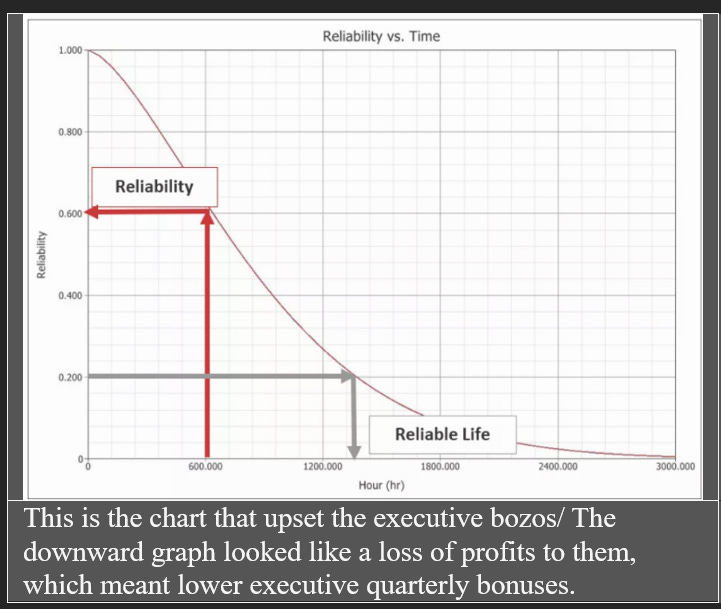
When I first presented my Ventak II data, it was with a chart (like the one above). Normally, product reliability curves downward with time; there is no avoiding that with any product, but it’s especially a product that includes a battery. However, a product with an expected five year lifetime that is only a year or two out of early, European clinical trials shouldn’t be showing any measurable failure rate. The Ventak II was not performing as expected and, since it had only been available in the US for a year or so, issuing a warning (at the least) to physicians could have given the company a heads-up on a dangerous failure situation early enough to prevent substantial patient harm. So, I made the presentation to the executive group that, supposedly, was tasked with making those kinds of decisions.
Once before, when a pacemaker was exhibiting signs of premature battery failure, I’d presented similar information to a similar group and the only question I’d received was from the CEO, “How would a recall affect my bonus?” (Apparently, not an unusual question from that bunch.) This time, after my presentation, the department director pulled me aside and asked me to reformat my slide to product an upward slope because the execs in the meeting didn’t like data that produced a downward slope because it implied “loss of income.”
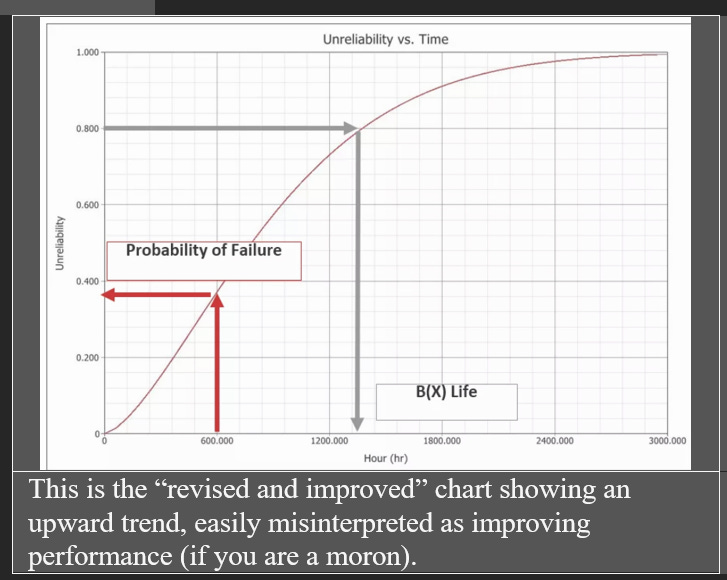
I honestly have to say that is one of the fuckin’ dumbest things I have ever heard from anyone pretending to be an adult. By that time, I’d put in 30 years in corporate America and I was pretty used to hearing astoundingly stupid things from executives. Still, that one pushed the boundaries pretty hard. So, the next week after I’d acquired a little more failure data and a lot more understanding of the failure mechanism, I provided the graph (above) in my presentation. The execs were “happy” with the graph, but obviously it didn’t accomplish anything because the last generation of Ventak ICDs weren’t recalled until 2005 (unwillingly, as a result of an FDA investigation and a Cleveland Clinic cardiologist who produced his own database) for two more generations of equally flawed medical devices.
By then, I’d been out of the industry for more than 4 years and there was a lot more stupidity to come after I’d left. Those two charts, though, and the executive response to the same data presented, pictorially, two different ways says more than I can express in words. So, I guess a picture is “worth” a thousand words?